


Manufacturer Background
Quest is a metal detecting brand known for budget to mid-range VLF detectors and accessories, with an emphasis on simple controls, lightweight builds, and accessible pricing across Europe and the UK market.
Key Specifications
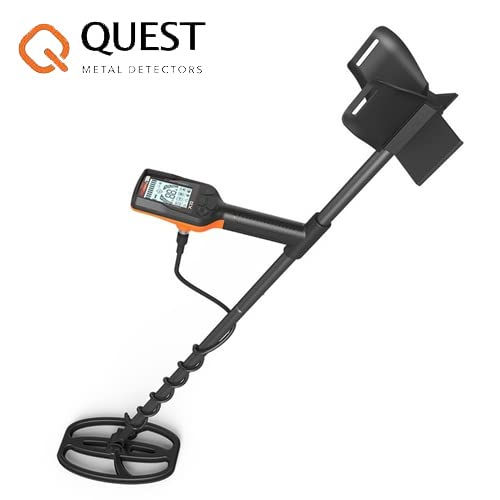
- - Coil: 11x10 inch TurboD Double-D search coil
- Operating principle: VLF motion metal detector
- Power: Internal rechargeable battery (USB charging)
- Display: Numeric Target ID with visual meter
- Audio: Multi-tone audio with adjustable volume and iron volume
- Controls: Simple menu with sensitivity and discrimination adjustments
- Build: Lightweight S-stem with cam locks
- Waterproofing: Waterproof coil; weather-resistant control box
- Headphones: 3.5 mm wired headphone jack
Review — Performance & Use
Positioned as an entry-to-mid detector, the Quest X10 IDmaxX aims to deliver straightforward performance on typical UK ground without the learning curve of advanced menus. On pasture and lightly worked plough, it handles everyday coin and small artefact hunting competently once sensitivity and reactivity are balanced against local chatter. The 11x10 inch TurboD coil gives decent sweep coverage and helps with field-walking efficiency, and the coil’s DD footprint copes reasonably well with mineralised soils and the iron flecks you encounter on older farmland. Target audio is clear and uncomplicated, with an immediately readable numeric Target ID that helps you decide whether to pop a plug or keep walking. As with many VLF detectors in this price band, deep targets at the fringe of detection can produce jumpier IDs, especially on scarred or misshapen conductors—thin hammered silvers, clipped coins, and small bronzes that UK sites are famous for—so you’re still relying on tone behaviour and repeatability rather than rigid numbers. In comparative UK testing resources, the X10 IDmaxX is frequently set against Quest’s own X10 Pro and the Q35. The IDmaxX tends to be praised for its simple setup and value, while the Q35 is favoured for broader feature depth; both patterns appear in retailer notes, community threads, and video tests. On pasture with moderate modern trash, the machine’s recovery speed and coil control let it separate reasonably in iron, provided you keep a sensible sweep speed and avoid overswinging the nose of the coil. Iron volume control is useful for a long day on plough-strewn stubble where constant ferrous grunts can wear you down; dialing it back reduces fatigue without blinding you to changes in site texture. The numeric ID is useful for quickly learning site baselines—where foil, lead, and small buckles tend to sit on your particular permission—though, as usual, conductive overlap remains real on distorted or tiny targets. In UK-specific low-conductive test sets, the detector shows it can find the small and awkward conductors if you stay methodical and push your sensitivity to the site’s limit without inviting EMI. The extended blade-shaped coil helps in ploughed furrows by letting you scan ridges and troughs without constantly re-levelling the coil face. On older pasture where ground is compacted, a slower sweep and willingness to interrogate faint, two-way wisps pay dividends; shallow ring pulls will sound obvious, while subtle medieval bits require patience and small wiggles to coax a repeatable tone. On beaches, inland dry sand behaves like any other low-mineral ground, but wet salt remains challenging for most single-frequency VLFs; unless you see repeated UK reports to the contrary or manufacturer emphasis on salt performance, treat wet sand claims with caution. Power is via an internal rechargeable battery, which keeps weight down and eliminates loose battery doors in the rain. The stem and cam locks are straightforward and stable, and the control box is weather-resistant; the coil is submersible, so you can work in puddled furrows and shallow stream edges. The learning curve is short. Beginners will appreciate the clear target ID and simple discrimination, while experienced diggers can run it fairly open on old sites to listen for nuance. Overall, the X10 IDmaxX is not trying to dethrone flagship multi-frequency machines; it aims to be an honest workhorse for UK farmland and club digs, trading encyclopaedic feature sets for a clean interface, sensible ergonomics, and a price that leaves room for fuel and permissions. (Sourced from outside the UK) Manufacturer material emphasises depth gains and general performance improvements; UK testers and retailers provide the context that matters here—how it behaves on pasture and plough, where it delivers steady, usable hits provided you keep expectations realistic for the class.
Quoted Insights
UK testing resources compare the X10 IDmaxX directly with the X10 Pro, noting that the newer model offers practical, usable performance on low-conductive targets when settings are dialled in; the takeaway is that it’s a capable farm-field companion rather than a feature-chasing upgrade.
https://www.staffsmetaldetectors.co.uk/test-results
Retailer listings in the UK highlight the 11x10 inch TurboD DD coil and position the X10 IDmaxX as a value-led detector suitable for mixed farmland where you need coverage and stability more than advanced programmability.
https://spinadiscmetaldetectors.com/products/quest-x10-idmaxx-metal-detector-1
Community discussions in UK groups regularly weigh the X10 IDmaxX against the Q35, with sentiment splitting along price-versus-features; the IDmaxX earns nods for ease of use and weight, while the Q35 attracts those who want more tweakability.
https://www.facebook.com/groups/577381149630721/posts/1413127056056122/
(Sourced from outside the UK) A manufacturer video pushes ‘huge search depth’ messaging; UK hobbyists typically translate that into realistic field behaviour: solid everyday depth for the class and conditions, with IDs that get wobblier as you approach fringe targets.
https://www.youtube.com/watch?v=x_OhDEZRRTA
Pros
- Lightweight build and simple controls make it easy to live with on long UK pasture days; 11x10 inch DD coil balances coverage and separation for field-walking; Clear numeric Target ID and iron volume help decision-making and fatigue management; Rechargeable battery and weather-resistant design suit British changeable conditions; Strong value in the entry-to-mid price band with a very short learning curve.
Cons
- Single-frequency VLF limitations on wet salt remain; Target ID stability drops on deep or distorted conductors; Fewer advanced features and profiles than pricier rivals; Coil size can feel broad in extreme iron carpets around old habitation; UK accessory and coil ecosystem is smaller than for mainstream flagship platforms.
Conclusion
If your week is mostly pasture and plough, and you want a detector that gets out of the way, the Quest X10 IDmaxX earns its keep. It tracks solidly with the realities of UK detecting: ground that varies by the acre, iron that never quite goes away, and a hobby that rewards patient, systematic listening. The IDmaxX’s big wins are comfort, clarity, and price. You can cover ground efficiently, read the machine quickly, and avoid drowning in menus. It is not a miracle-worker on wet salt and it will not rewrite the target ID playbook at extreme depth, but that is honest and expected for its class. Against Quest’s own stablemates, it plays the role of the straightforward all-rounder: easier than the more feature-rich options, with enough control to thrive on typical permissions. For newcomers, it offers a forgiving on-ramp to UK fields; for experienced diggers, it can act as a reliable backup or a lightweight primary for casual club days. Measured against the price of a weekend rally, the value proposition is strong—particularly if your sites reward methodical coverage more than micro-tuning.
Manufacturer Page
Where to Buy (UK)
Further Reading
Bibliography
X10 IDmaxX product page — Cross-referenced only (validation/fact-check)
Metal Detectors category (lists X10 IDmaxX) — Not used in drafting
Quest X10 IDmaxX Metal Detector — Cross-referenced only (validation/fact-check)
Quest X10 IDmaxX Metal Detector Bundle — Not used in drafting
QUEST X10 IDMAXX METAL DETECTOR — Not used in drafting
Quest Metal Detector X10 IDmaxX with High Performance Blade 11"x10" TurboD Dual D Coil — Cross-referenced only (validation/fact-check)
Test Results — Quest X10 Pro v Quest X10 IDmaxX — Directly informed the review
Low Conductive Coins — New Detector Tests (includes X10 IDmaxX) — Directly informed the review
Quest Q35 VS Quest X10 IDmaxX — Who’s Winner? — Directly informed the review
Quest Detectors Forum (brand section; includes IDmaxX threads) — Directly informed the review
Quest X10 Pro v Quest X10 ID MaxX Metal Detector Tests — Directly informed the review
HUGE SEARCH DEPTH! Experience the NEW Quest X10 IDmaxX Metal Detector! — Cross-referenced only (validation/fact-check)
Metal Detector QUEST X10 IDmaxX — Unboxing e Menu — Not used in drafting
Szybki test nowego Quest X10 IDMAXX — Not used in drafting
QUEST X10 IDMAXX..WHO IS DOING IT WRONG? — Not used in drafting
UK Detectorist research conducted by
- Holly