




Manufacturer Background
Nokta is a Turkish detector manufacturer (formerly known as Nokta Makro) with a strong UK dealer network. The brand is known for delivering high-spec waterproof machines at aggressive prices and for regular firmware updates, with the Simplex line becoming a staple entry-to-mid tier choice across UK hobbyists and clubs.
Key Specifications
- - Operating frequency: 15 kHz
- Search modes: Field, Park, 4 Tone, 99 Tone, Beach, All Metal
- Waterproof rating: IP68; fully submersible to 5 m (16 ft)
- Weight: 1.2 kg (2.6 lb)
- Shaft: Fully carbon fibre; retracts to 63 cm (25 in)
- Included coil: SX28 28 cm (11 in) DD with coil cover
- Target ID range: 01–99 with notch discrimination
- Sensitivity: 30 levels; frequency shift for EMI
- Ground balance: Automatic and manual
- Audio: Vibration on target; tone break, tone volume, 4-tone and 99-tone options
- Lighting: LCD backlight, keypad backlight, LED flashlight
- Battery: 2300 mAh Li‑Po; USB charging; firmware updatable
- Wireless audio: Bluetooth aptX Low Latency compatible (WHP packs include headphones)
- Warranty: 3 years (manufacturer)
Review — Performance & Use
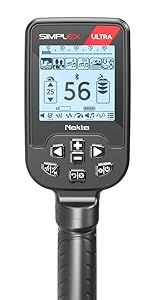
The Simplex Ultra is the most capable model in Nokta’s ‘New Generation’ Simplex trio and, in UK terms, it hits a very particular sweet spot: proper waterproofing to 5 m, a fully carbon fibre shaft that actually feels rigid on long swings, and controls that strike a balance between turn‑on‑and‑go and enough tweakability to grow with you. On the official spec sheet you get Field, Park, 4‑Tone, 99‑Tone, Beach and All Metal modes, a 01–99 target ID, vibration, full lighting, and simple frequency shift. That is the bones of it. What matters to most of us is how it behaves on UK permissions—pasture, plough and that painfully common ‘busy’ old ground.
Pasture first. With the stock SX28 (11 in) coil, Field mode gives the most confident audio on non‑ferrous while still letting iron grunt through if you keep iron volume audible rather than muted. Several long‑running MDF threads discuss taming the Simplex family’s ‘chattiness’, and the recipe translates well to the Ultra: don’t be afraid to drop sensitivity a couple of notches if the site is sparky, ground balance with a clean pump, and use the frequency shift when you pick up fencing buzz or another detectorist nearby. Set tone break so that very low conductors don’t smear into mid‑tones, then sweep low and deliberate. On quiet pasture the 99‑Tone option can be rewarding—there’s more nuance on deep whispers—yet for many ears 4‑Tone is calmer and faster to read, especially in wind. The shaft is genuinely rigid for a budget unit, and the 1.2 kg balance means you can lengthen the rod for wide arcs without aching shoulders by lunchtime.
Ploughed and turned ground asks for a different compromise. The SBS (swing‑bounce‑settle) problem on clods can provoke falses on any single‑frequency machine. Here the Ultra’s snappy recovery speed and simple gain staging help: drop sensitivity until falsing calms, keep recovery brisk with 4‑Tone, and consider the smaller SX24 coil if trash is dense. Community posts point out that the Simplex platform will still ping shallow iron with attractive numbers; the Ultra’s notch and tone‑break let you be pragmatic without completely blinding yourself to borderline artefacts. On mid‑conductive hammered and small buckles the ID will wander—again, single‑frequency physics—but repeatable tones plus a stable 2‑way response are the tells. When the ground dries out after a few weeks of sun, re‑ground‑balance and expect more ‘sparks’ around hot rocks; frequency shift cures much of it.
The build is a real step up from older budget sticks. The fully carbon fibre rod doesn’t twist under coil torque, the arm cup is sturdier than most at this price, and the retract‑to‑63 cm travel length actually fits diagonally in small car boots and rucksacks. The control box lighting and keypad backlight are practical on winter afternoons, and the haptic buzz is surprisingly useful when wind drowns out audio. Wireless audio support is via Bluetooth aptX Low Latency, so if you buy a ‘WHP’ bundle from a UK dealer you’ll be up and running without laggy third‑party cans; if you don’t, the 3.5 mm adapter and cabled phones work fine.
Beach performance is where many UK buyers get nervous. The Ultra is a single‑frequency 15 kHz machine. On our salt‑rich wet sand that means you will not get the same quiet ride as a modern simultaneous multi‑frequency unit. However, multiple UK videos show it can be set up to work respectably in the shallows: use Beach mode, perform a careful ground balance on the wet line, keep sensitivity conservative and listen for consistent, repeatable hits rather than chasing every chirp. For dry sand and damp slopes it is perfectly serviceable. If your detecting diet is mostly wet salt beaches, the value equation tilts toward a multi‑frequency detector; if you’re an inland detectorist who occasionally fancies a tide window, the Ultra will do the job with a bit of patience.
Where the Ultra earns loyalty on UK farmland is its combination of stability, ergonomics and price. MDF contributors consistently praise the feel and build for the money, and that tracks with UK dealers who keep recommending it as a first ‘serious’ detector that you won’t outgrow in a season. The modes are sensibly named and the menu is flat enough that you’re never more than a couple of clicks away from a useful control. Unlike some rivals, the numerical ID scale is clean and the iron off control is quick to toggle when you want to sanity‑check a spitty mid‑tone. The coil ecosystem is also a plus: SX24 for iron‑infested patches, SX28 as the all‑rounder, and SX35 if you work big, reasonably clean pasture. Swap coils and it still balances well.
Limitations? They’re honest ones. On certain iron‑littered pasture the Ultra will still tempt you into nail heads until your ear is tuned; 99‑Tone takes time to master; IDs on tiny, deep hammered will float. None of this is surprising at 15 kHz and this price bracket. What matters is that it remains predictable once you learn its tells. If you want a waterproof, hard‑wearing detector with sensible ergonomics that behaves on pasture and plough, and you’re content to treat wet sand as an occasional side quest, the Simplex Ultra is very easy to recommend as a UK daily driver.
Quoted Insights
UK users repeatedly emphasise value, build and practical setup tips, with a recurring theme that the Ultra rewards steady settings and sensible expectations on wet salt.
"Fully submersible up to 5 meters (16ft)."
https://www.noktadetectors.com/metal-detector/simplex-ultra/
"Shaft retracts down to 63cm (25'')."
https://www.noktadetectors.com/metal-detector/simplex-ultra/
"Field, Park, 4 Tone, 99 Tone, Beach, All Metal."
https://www.noktadetectors.com/metal-detector/simplex-ultra/
From the UK forum side, early adopters of the New Generation models posted that the Ultra upped frequency to 15 kHz and improved ergonomics—context that explains its lively, ‘talkative’ audio on certain sites when sensitivity is pushed. That chatter is manageable once you dial in tone breaks and don’t try to run it maxed everywhere. One owner’s first‑hand summary captures the mood:
"it's fantastic… the build quality and performance is out of this world… I don't think you will ever pick up a lighter detector at anything like this price"
https://www.metaldetectingforum.co.uk/viewtopic.php?t=148753
YouTube reviews from UK channels help set realistic beach expectations. Titles tell their own story:
"Simplex Ultra Does It Again! (UK field)"
https://www.youtube.com/watch?v=Wtdb3GZz14s
"Nokta SIMPLEX ULTRA on SALTWATER BEACH (Essex, UK)"
https://www.youtube.com/watch?v=txsTMoNYpCI
Aggregated buying guides from UK hobbyist blogs position the Ultra among the best mid‑range value options for mixed British conditions, parks through pasture, provided you’re comfortable learning its audio:
"These detectors represent some of the best options in the £400–£600 price range"
https://www.swingbeepdigrepeat.com/choosing-the-best-mid-range-metal-detector-in-the-uk/
Retailer listings add practical detail UK buyers care about—WHP bundles with aptX Low Latency headphones, coil options like the SX24 for tight sites—and reinforce that the weight lands around 1.2 kg. While those pages are sales material, they align with hands‑on commentary from forums and channels, which is why we used them for cross‑checks rather than to set expectations. Overall sentiment: the Ultra is a robust, waterproof, genuinely usable detector that punches above its bracket inland, and can be coaxed into workable behaviour on wet salt for occasional beach trips.
Pros
- Waterproof to 5 m; fully carbon fibre shaft and 1.2 kg weight; simple but capable menu; useful 4‑Tone and 99‑Tone options; strong value for UK farmland/pasture; good coil ecosystem (SX24/SX28/SX35); vibration and full lighting are genuinely practical; Bluetooth aptX Low Latency support via WHP bundles.
Cons
- Single‑frequency 15 kHz—less stable on UK wet salt than SMF machines; can sound ‘chatty’ on busy pasture until settings are tamed; target ID drifts on tiny deep hammered; standard Ultra pack may not include headphones—check WHP bundles.
Conclusion
If you detect mainly inland in the UK—pasture, rolled stubble, occasionally a ploughed field—the Simplex Ultra is exactly the kind of machine that keeps weekends simple. It is waterproof enough for rivers and winter downpours, light enough to swing all day, and built on controls that get out of the way. The important context is honest physics: 15 kHz single frequency means a little more feedback in mineral or iron, and more juggling on wet salt than a modern multi‑frequency unit. But what you get in return is a predictable, tough, affordable detector with a learning curve that rewards time on the headphone rather than hours in nested menus.
Compared with similarly priced rivals, the Ultra’s carbon fibre build and IP68 rating are standout advantages, as is the sensible coil family that lets you tailor it to a site. Community sentiment from UK forums and channels consistently backs that up: owners praise the feel and durability, beginners manage early chatter by trimming sensitivity and using Field or Park modes, and more experienced users graduate to 99‑Tone for nuance on deeper whispers. On mixed inland permissions that balance is exactly what most hobbyists need. Yes, hardcore beach hunters should step up to a simultaneous multi‑frequency platform, but for an inland detectorist who wants a waterproof all‑rounder that doesn’t feel like a toy, the Ultra is easy to recommend.
In short: buy it for pasture and plough where its stability, ergonomics and value shine; treat beach work as an occasional extra where it remains usable with the right setup. If you later want multi‑frequency performance, the Ultra still makes sense as a rugged backup or loaner. That ‘keeps its place’ quality is why the model has stuck in UK kit bags—it simply delivers more detector than the price suggests.
Manufacturer Page
Where to Buy (UK)
Further Reading
Bibliography
- Simplex ULTRA Metal Detector — Directly informed the review
- SIMPLEX New Generation — User Manual (EN) — Cross-referenced only (validation/fact-check)
- Nokta Simplex ULTRA with Headphones — New Generation — Cross-referenced only (validation/fact-check)
- Nokta Simplex Ultra Metal Detector — Cross-referenced only (validation/fact-check)
- Simplex Ultra WHP (With Headphones) — Cross-referenced only (validation/fact-check)
- Field Tests – Nokta Simplex Ultra (download) — Cross-referenced only (validation/fact-check)
- Choosing the Best Mid Range Metal Detector in the UK (includes Simplex Ultra) — Directly informed the review
- Simplex Ultra — Directly informed the review
- NEW Generation – Lite, BT and Ultra — Directly informed the review
- Found with my Nokta Simplex Ultra (axe ID help) — Not used in drafting
- Simplex Ultra Does It Again! (UK field) — Directly informed the review
- Nokta SIMPLEX ULTRA on SALTWATER BEACH (Essex, UK) — Directly informed the review
UK Detectorist research conducted by
- Holly